

Il tuo carrello
Notizie Aziendali
E-Malt news
UK & South Korea: New UK-South Korea deal to benefit exports of Guinness, cars, Scottish salmon
UK: UK brewers facing “heavy headwinds” from increased taxation, other issues
Japan: Kirin set to ramp up beer development via proprietary AI
Norway & Sweden: Olvi Group acquires majority share in Brewery International group
I nostri malti

I nostri luppoli
-
 NELSON SAUVIN BIOLOGICO (NZ) Pellets T90 (5KG)
Aggiungi al carrello
NELSON SAUVIN BIOLOGICO (NZ) Pellets T90 (5KG)
Aggiungi al carrello
-
CHALLENGER BIOLOGICO (BE) Pellets T90 (5KG)
Aggiungi al carrello
-
NELSON SAUVIN (NZ) Pellets T90 (5KG)
Aggiungi al carrello
-
SIMCOE (USA) PELLETS T90 (5KG)
Aggiungi al carrello
-
HALLERTAU SMARAGD BIOLOGICO (DE) Pellets T90 (5KG)
Aggiungi al carrello
Luppoli nuovi

I nostri lieviti



Le nostre spezie

I nostri zuccheri

I nostri tappi
-
 Kegcaps 74 mm, Giallo 4 Flatfitting A-type (700/box)
Aggiungi al carrello
Kegcaps 74 mm, Giallo 4 Flatfitting A-type (700/box)
Aggiungi al carrello
-
Kegcaps 74 mm, Bianco 86 Flatfitting A-type (700/box)
Aggiungi al carrello
-
Kegcaps 69 mm, Bianco 86 Grundey G-type (850/box)
Aggiungi al carrello
-
 Tappi 26mm TFS-PVC Free, Mustard yellow col. 20164 (10000/box)
Aggiungi al carrello
Tappi 26mm TFS-PVC Free, Mustard yellow col. 20164 (10000/box)
Aggiungi al carrello
-
 Tappi 26mm TFS-PVC Free, Green Transparent col. 2722 (10000/box)
Aggiungi al carrello
Tappi 26mm TFS-PVC Free, Green Transparent col. 2722 (10000/box)
Aggiungi al carrello
Ricette per birra


Certificati
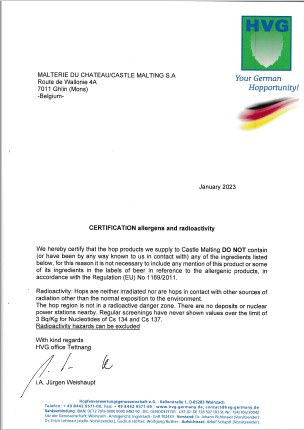 HVG Hops Certification allergens and radioactivity 2022
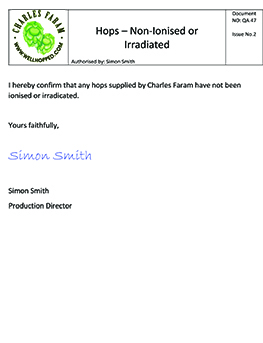 ChF Hops Non-Ionization and Non-Irradiation Certificate
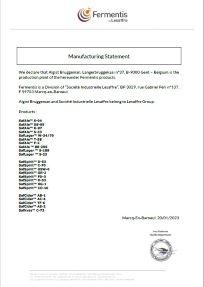 Fermentis Yeast Manufacturing Statement 2023
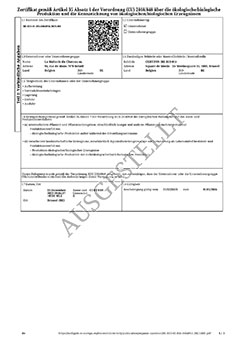 Bio-Zertifikat DE - Juli 2025-März 2028
 La Malterie du Chateau | FCA Malt Certificate (English) (2024-2027)
Suggerimento
Join us



 Australia: Barley crop forecast to be the fifth-largest on record in 2025
National forecaster ABARES has increased its forecasts for Australia’s three biggest winter crops in its quarterly Australian Crop Report released on March 3.
Its national wheat estimate now stands at 34.1 million tonnes (Mt), the third-largest on record, up from 31.9Mt seen in December.
Canola is now seen at 5.9Mt, up from 5.6Mt in the previous forecast, and the fourth-largest crop on record, while barley at 13.3Mt is up from 11.7Mt seen in December to make it the fifth-largest crop on record.
“Grain receival data indicates that yields were better than expected, particularly in Western Australia and New South Wales, where total winter-crop production has been revised up 19 percent and 6pc respectively from the December 2024 forecast,” the ABARES report said.
“Poor seasonal conditions in South Australia and Victoria limited yield potential of winter crops, with total production estimated to be down 40 percent and 31pc respectively year on year.”
ABARES puts the total national winter crop, including pulses, as the third-largest on record at 59.8Mt.
Area planted to winter crops in 2024-25 is estimated to have increased by 8pc from 2023-24 to 24.9M hectares.
This is a new national record, driven by a greater area planted to winter crops in New South Wales, up 27pc year on year, and Queensland, up 38pc.
Favourable seasonal conditions at the time of planting led to area increases in both states, with many expanding into regions not normally sown to winter crops, such as north-west NSW.
Torna