

Новини компанії
E-Malt news
EU & UK: Barley production forecast to decline to 58.2 mln tonnes in 2026
USA, PA: Big Bottom Brewery closes brewery and taproom in Dillsburg
USA, NM: Bosque Brewing Company closing all of its Santa Fe locations
Japan: Asahi sees sales fall at faster pace in November
Наш солод
Наш хміль


New Hops

Наші дріжджі


Наші спеції


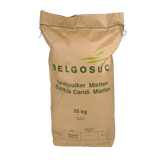
Наш цукор
Наші кришки
-
 Кришки 26mm TFS-PVC Free, Champagne Opaque col. 2713 (10000/Коробка)
Додати до кошика
Кришки 26mm TFS-PVC Free, Champagne Opaque col. 2713 (10000/Коробка)
Додати до кошика
-
 Кришки для кег 64мм, Червоні 102 Sankey S-тип (ЄС) (1000/Коробка)
Додати до кошика
Кришки для кег 64мм, Червоні 102 Sankey S-тип (ЄС) (1000/Коробка)
Додати до кошика
-
 Кришки 26mm TFS-PVC Free, Cyan Transparent col. 2892 (10000/Коробка)
Додати до кошика
Кришки 26mm TFS-PVC Free, Cyan Transparent col. 2892 (10000/Коробка)
Додати до кошика
-
Кришки для кег 64мм, Червоні 150 Sankey S-тип (ЄС) (1000/Коробка)
Додати до кошика
-
 Кришки 26mm TFS-PVC Free, Red Neu col. 2151 (10000/Коробка)
Додати до кошика
Кришки 26mm TFS-PVC Free, Red Neu col. 2151 (10000/Коробка)
Додати до кошика
Рецепти пива




Сертифікати
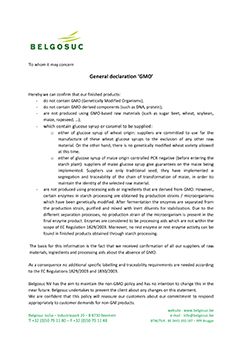 Belgosuc Sugar, GMO-Free Certificate 2019
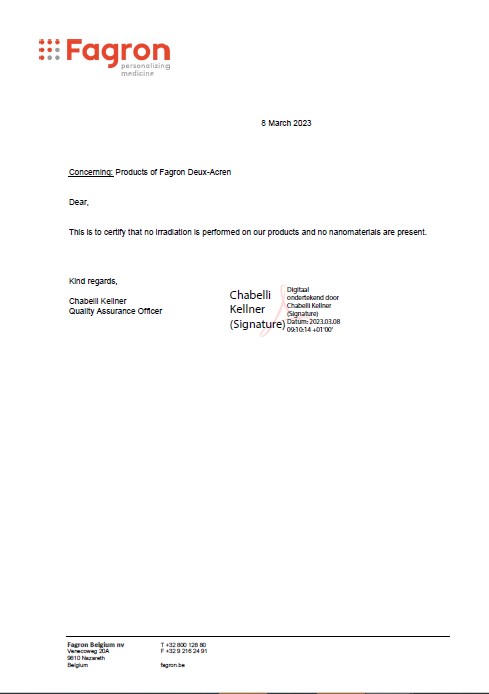 Fagron Spices, Certificate No Irradiation and Nanomaterials 2023
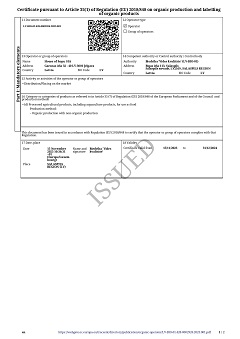 House of Hops Organic Certificate 2025
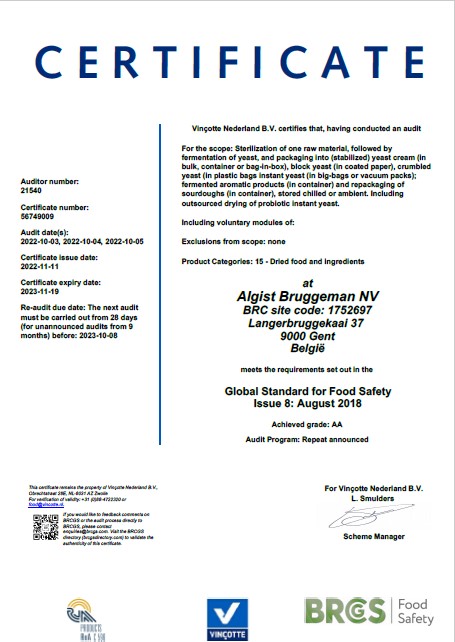 Fermentis Yeast Food Safety Certificate
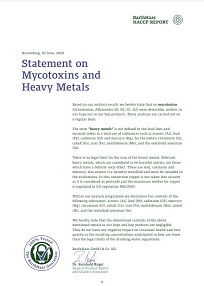 Barth Haas Hops: Statement on Mycotoxins and Heavy metals 2022
Suggestion
Join us



 Canada: Canadian farmers report an ‘outstanding’ malting barley crop this year
Canadian farmers produced an “outstanding” crop of malting barley this year, according to the Canadian Grain Commission, The Western Producer reported on December 11.
“Barley selected for malting in 2025 demonstrated excellent grain quality compared with 2024 and long-term data,” the commission stated in a recent report.
The average protein content was 11.8 per cent, which is below the 10-year average of 12 per cent.
Starch content was two to three per cent higher than last year.
“Gelatinization temperature was two to three degrees Celsius lower than in 2024 and this, along with higher starch, was favourable for malting,” stated the report.
Test weight, kernel weight and kernel plumpness were all above the 10-year average.
“Overall, the 2025 barley crop combined lower protein with heavier, plumper kernels and higher starch, underscoring its excellent malting potential and superior grain quality,” said the grain commission.
Peter Watts, managing director of the Canadian Malting Barley Technical Centre, said there is no question that maltsters and brewers will be pleased with Canada’s 2025 crop.
“We always associate plump kernels with high extraction for the brewers, which is very positive and what they want to see,” he said.
The heavy test weights are also beneficial for extraction and overall economics.
And it is nice to see the protein levels come down this year because they had been a bit on the high side the last couple of years.
“Maltsters and brewers are happy to see that as well, said Watts.
The grain commission noted that the 2025 crop has demonstrated “outstanding malting performance,” driven by its higher test weight, greater kernel plumpness and heavier kernels.
It produced a well-modified malt with high friability, strong enzyme activity and ample levels of soluble proteins and free amino nitrogen.
The wort had low beta-glucan concentrations and excellent viscosity values.
“Overall, the combination of enhanced physical grain traits and favourable biochemical properties underscores the excellent quality of the 2025 crop for malting and brewing applications,” said the CGC.
The proportion of the barley area seeded to malting barley varieties continues to decline in Western Canada.
It accounted for 46.2 per cent of the total barley area in 2025, down from 53.7 per cent in 2020.
General purpose barley, which is used for feed and forage, accounted for 48 per cent of the acres in 2025, up from 38.5 per cent in 2020.
The remainder was either food barley or unspecified.
“There has definitely been a drift downward in terms of malt barley seeded area, but we’re still producing a lot of malting barley,” said Watts.
Farmers produced 9.45 million tonnes of barley in 2025. Using the acreage breakdown would mean they harvested 4.37 million tonnes of malting barley.
Watts said maltsters usually select about 2.5 million tonnes per year, so there is a lot that will have to be sold as feed.
That might be one reason why growers are planting more feed varieties lately. Another is that there are some very high-yielding new feed varieties.
Alberta accounted for 55.5 per cent of total barley acreage, followed by Saskatchewan at 37 per cent and Manitoba with 6.3 per cent.
AAC Synergy was the most widely grown malting barley variety, accounting for 35.6 per cent of total malting barley acreage.
CDC Copeland (13.5 per cent), AAC Connect (11.7 per cent), CDC Churchill (9.6 per cent) and CDC Fraser (8.9 per cent) were other popular varieties.
Watts was not surprised that Synergy led the way because it is popular with both farmers and maltsters.
He was surprised that Connect dipped lower.
There was a big uptick in Churchill’s acreage. Growers love it because it’s an “exceptional yielder,” but it is still in the early days of garnering acceptance by maltsters and brewers.
Sirish, which was registered as a malting barley variety in 2017, captured 14 per cent of seeded area, but it is primarily used as a feed crop.
Newer varieties such as Bill Coors 100, CDC Goldstar and SY Stanza gained some ground in 2025, but each variety still accounts for less than one per cent of malting barley acres.
Area seeded to other minor varieties such as CDC Copper, CDC Bow, Newdale and AB BrewNet declined modestly.
Six-rowed cultivars accounted for 1.9 per cent of total malting barley area seeded in 2025, with Legacy leading the way at 1.6 per cent.
Назад