

Noticias de Empresa
E-Malt news
Canada, ON: Workers reach final deal as Diageo closes Crown Royal plant in Amherstburg
Australia: ABAREs lifts forecast for wheat, barley, canola crops
USA, WI: Nicolet Ale Works to move into a permanent new home
Pakistan: Murree Brewery restarts beer exports for the first time since prohibition imposed in 1977
Nuestras maltas



Nuestros lúpulos

New Hops

Nuestras levaduras




Nuestras especias

Nuestros azúcares

Nuestras tapas
-
 Kegcaps 74 mm, Azules 141 Flatfitting A-type (700/caja)
Añadir al carrito
Kegcaps 74 mm, Azules 141 Flatfitting A-type (700/caja)
Añadir al carrito
-
 Crown Caps 26 mm TFS-PVC Free, Dark Brown col. 2844 (10000/caja)
Añadir al carrito
Crown Caps 26 mm TFS-PVC Free, Dark Brown col. 2844 (10000/caja)
Añadir al carrito
-
 Tapas 26mm TFS-PVC Free, Blue Neu col. 2832 (10000/caja)
Añadir al carrito
Tapas 26mm TFS-PVC Free, Blue Neu col. 2832 (10000/caja)
Añadir al carrito
-
 Kegcaps 64 mm, Marron 118 Sankey S-type (EU) (1000/caja)
Añadir al carrito
Kegcaps 64 mm, Marron 118 Sankey S-type (EU) (1000/caja)
Añadir al carrito
-
 Crown Caps 26mm TFS-PVC Free, Doradas col. 2311 (10000/caja)
Añadir al carrito
Crown Caps 26mm TFS-PVC Free, Doradas col. 2311 (10000/caja)
Añadir al carrito
Recetas de Cerveza





Certificados
-
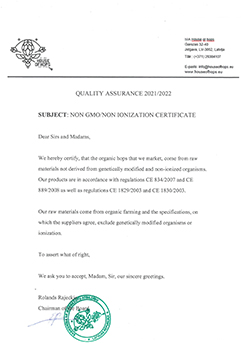 House of Hops - Non GMO / Non Ionization Certificate 2022-2023
-
 Belgosuc, Sugar, Kosher Certificates 2022-2023 - Belgosuc (English)
-
 Malt Attestation of conformity for non-irradiation, non-ionization, and the absence of nanomaterials 2024 (ENG)
-
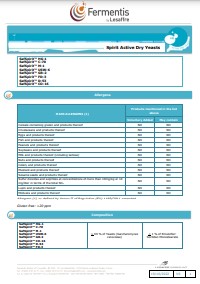 Fermentis - Spirit Dry Yeast Information 2023
-
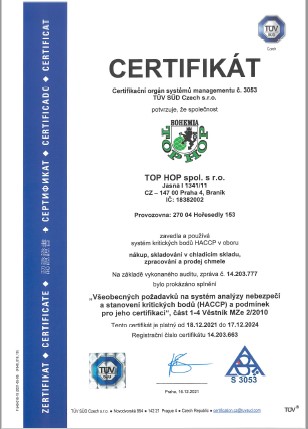 Top Hop - HACCP Certificate 2021-2024
Sugerencia
Join us



 Analysts: Malt industries are expanding elsewhere
Smaller exports are the consequence of expanding malt industries elsewhere, only in few countries (Japan) of lower consumption: Russian industries have grown from a capacity of ½ Million to 1 Million tonnes in a few year’s time, and the figure will reach 1.4 million tonnes by 2006.
In the Ukraine 240,000 tonnes are produced now, plans are to add another 100,000 tonnes. These markets will be lost or at least strongly reduced for EU exports.
In the Mercosur, where Brazil used to be a great customer, import taxes protect internal markets, local industries work at 100 % of their capacities, and one new malthouse for 100,000 tonnes will be built in Argentina.
Australia does extremely well because of its proximity to growing markets in Southeast and Far East Asia, and because of its government’s liberal trade policies. A Free Trade Agreement with Thailand is in force, others are being negotiated, giving Australian malt duty-free access to large markets.
By comparison, the EU has failed to work out an FTA with Mercosur and now relies on WTO to come to worldwide better trade rules in the future. Meantime Australia constructs new factories for an added production of 150,000 tonnes.
Regresar