

Company News
Industry News
Americas: Heineken appoints Alex Carreteiro as Regional President Americas
Europe: Europe’s beer market continues to contract for the fifth consecutive year
UK: AHDB releases 2026/2027 recommended lists of cereals and oilseeds
USA, MD: Watchtower Brewing Company becomes Aberdeen’s first brewery
Our Malts



Our Hops

New Hops

Our Yeasts



Our Spices


Our Sugars

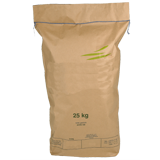
Our Caps
-
 Kegcaps 69 mm, Blue 141 Grundey G-type (850/box)
Add to cart
Kegcaps 69 mm, Blue 141 Grundey G-type (850/box)
Add to cart
-
 Kegcaps 64 mm, Brown 153 Sankey S-type (EU) (1000/box)
Add to cart
Kegcaps 64 mm, Brown 153 Sankey S-type (EU) (1000/box)
Add to cart
-
Kegcaps 69 mm, Red 102 Grundey G-type (850/box)
Add to cart
-
 CC29mm TFS-PVC Free, Red with oxygen scav. (7000/box)
Add to cart
CC29mm TFS-PVC Free, Red with oxygen scav. (7000/box)
Add to cart
-
 CC29mm TFS-PVC Free, Green with oxygen scav.(6500/box)
Add to cart
CC29mm TFS-PVC Free, Green with oxygen scav.(6500/box)
Add to cart
Beer Recipes





Certificates
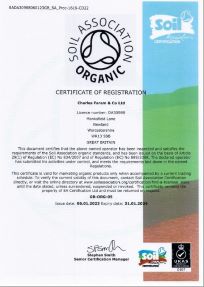 ChF Hops Organic certification, EN 2023-2024
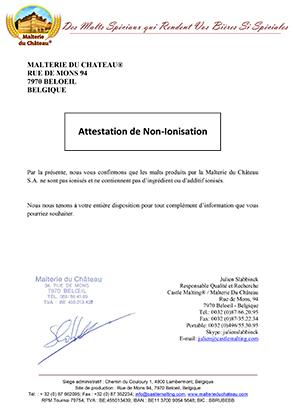 Castle Malting Malt Non Ionization Certificate FR
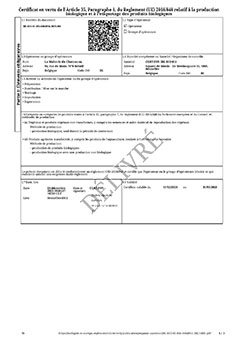 Certificat BIO FR: Malt, Houblon, Sucre - juillet 2025- mars 2028
 Hops, HVG, Organic Certificate 2024
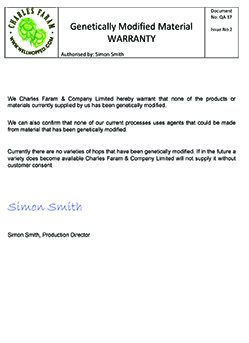 ChF Hops GMO-free Certificate
Suggestion
Join us



 Canada: Grain harvest campaign ramps up in Canada
Canadian farmers are at the pointy end of their 2025-26 grain-production cycle with this year’s harvest now underway across much of the Prairies. Thunderstorms and cooler temperatures dominated the weather cycle in many regions in the second half of August, benefiting late-planted crops but delaying early harvest operations, Grain Central reported on 3.
Analysis of the latest Normalised Difference Vegetation Index (NDVI) produced using high-resolution satellite data indicates that overall plant health across the Prairie provinces at the end of July varied considerably, ranging from much lower than normal to much higher than normal, pointing to highly variable yields at harvest.
However, wetter weather in August has reduced that inconsistency and significantly improved the production outlook. The overall harvest in Saskatchewan was reported to be 12 percent complete as of Monday last week, an advance of only three percentage points over the preceding week. Reaping operations across the province, as of August 25, continue to trail the five-year average of 25pc as well as the 10-year average of 21pc.
Around 70pc of winter wheat was reported to be in the bin as of August 25, while 45pc of peas and 35pc of lentils had been combined. The harvest of spring cereals is gradually increasing, with barley sitting at 17pc complete, and durum at about 13pc. The first paddocks of spring wheat, oats, and chickpeas are also starting to come off, though progress is limited, and canola was pegged at 1pc harvested.
Harvest progress in Manitoba remained slow in the week to August 25, with thunderstorms hampering operations in many areas. Some districts reported rainfall in excess of 100mm over a two-day period, but registrations of less than 30mm were more common. With headway across both autumn and spring-seeded paddocks at just 10pc, Manitoba’s farmers only managed to move the harvest needle six percentage points across the week. Harvest of winter cereals in Manitoba is almost complete, with yields generally reported in the 3.4-5.4 tonnes-per-hectare range for winter wheat, 3.6-5.4t/ha for oats, and 3.2-3.8t/ha for barley. Early canola yields are reported between 2.5-3.4t/ha, while field pea yields ranged widely but averaged around 4t/ha.
Last week’s Alberta harvest report suggests the yield potential of the province’s winter and spring crops is improving as the campaign advances. Crop conditions across the province are currently rated 65pc good to excellent, compared to the five-year average of 50pc and the 10-year average of 54pc. As of August 26, the province’s farmers had completed 11pc of the total task, four percentage points behind the five-year average. Harvest of autumn-seeded crops is almost complete, half of the spring-seeded pulses are off, reaping of spring-seeded cereals has begun on the earlier planted fields, and windrowing of canola paddocks has commenced.
Statistics Canada updated this season’s field crop production estimates late last week based on yield model estimates utilising satellite imagery and agroclimatic data. The nation’s farmers are projected to produce more canola, corn for grain, oats and lentils, but less spring wheat, durum wheat, soybeans and barley compared to 2024.
Wheat production is now forecast to edge 1.1pc lower year on year to 35.5 million tonnes (Mt) nationally in the 2025-26 season. This is primarily attributable to a 1.2pc fall in average yield to 3.34t/ha, with the harvested area unchanged at 10.7Mha. However, this year’s wheat crop forecast is still 6.4pc and 1.9pc higher than the 2023 and 2022 harvests respectively.
By category, Canada’s spring wheat output is predicted to decline by 2pc to 26Mt on the back of a 1.5pc decrease in the harvested area compared to 2024. Durum production is estimated to be 4.7pc lower than the previous harvest at 6.1Mt, although this does follow a 43.1pct increase in output in 2024 compared to 2023. Conversely, the winter wheat projection is 14.3pc higher at 3.5Mt, with favourable autumn planting conditions leading to a 20.9pc jump in the harvested area.
Canadian barley production continues its recent downward trend, declining a further 1.9pc this year compared to last to 8Mt, despite an increase in the average yield from 3.4t/ha to 3.58t/ha. This follows decreases of 8.6pc and 10.8pc at the 2024 and 2023 harvests, respectively.
This year’s crop projection is 2Mt lower than the 10Mt reaped in 2023, with harvested area being the culprit, declining from 2.6Mha hectares in 2022 to 2.2Mha this year. Since the 7.9Mt crop in 2017, only the drought-reduced barley harvest of 7Mt in 2021 has been smaller than the current season’s barley outlook.
Statistics Canada’s model-based production estimate pegged canola output at 19.9Mt, 3.6pct higher than the 2024 harvest. Yield has done all the work, improving from 2.17t/ha to 2.3t/ha, while the harvested area is forecast to be 2pc lower year on year at 8.7Mha. The crop in Saskatchewan, the biggest canola-producing province, is expected to rise by 5.9pc to 11.1Mt. TheAlberta crop is also expected to increase by 2.8pc, but production in Manitoba is forecast to take a 2.2pc hit.
On the pulse front, dry field peas and lentils account for the vast majority of Canada’s output, with harvest projections putting production at 3.4Mt and 2.7Mt respectively, up 13.7pc and 9.2pc compared to the 2024 campaign.
Corn is the dominant row-crop in Canada each season, with production currently forecast to increase 1.4pc to a record 15.6Mt compared to 2024, surpassing the previous benchmark of 15.4Mt set in 2023. Yields are projected to decrease 1.7pc from 10.59t/ha to 10.41t/ha, but a 3.1pc increase in the area to be harvested to 1.5Mha more than compensates. Conversely, the soybean harvest is expected to decrease by 7.3pc to 7Mt. This is despite a 1.3pc rise in the harvested area projection to 2.3Mha, with an 8.5pc decrease in yield to 3.02t/ha doing all the damage.
Back