

Company News
Industry News
Americas: Heineken appoints Alex Carreteiro as Regional President Americas
Europe: Europe’s beer market continues to contract for the fifth consecutive year
UK: AHDB releases 2026/2027 recommended lists of cereals and oilseeds
USA, MD: Watchtower Brewing Company becomes Aberdeen’s first brewery
Our Malts

Our Hops

New Hops

Our Yeasts

Our Spices



Our Sugars
Our Caps
-
 Kegcaps 69 mm, Blue 141 Grundey G-type (850/box)
Add to cart
Kegcaps 69 mm, Blue 141 Grundey G-type (850/box)
Add to cart
-
 Kegcaps 64 mm, Brown 153 Sankey S-type (EU) (1000/box)
Add to cart
Kegcaps 64 mm, Brown 153 Sankey S-type (EU) (1000/box)
Add to cart
-
Kegcaps 69 mm, Red 102 Grundey G-type (850/box)
Add to cart
-
 CC29mm TFS-PVC Free, Red with oxygen scav. (7000/box)
Add to cart
CC29mm TFS-PVC Free, Red with oxygen scav. (7000/box)
Add to cart
-
 CC29mm TFS-PVC Free, Green with oxygen scav.(6500/box)
Add to cart
CC29mm TFS-PVC Free, Green with oxygen scav.(6500/box)
Add to cart
Beer Recipes
Certificates
 ChF Hops Organic certification, EN 2023-2024
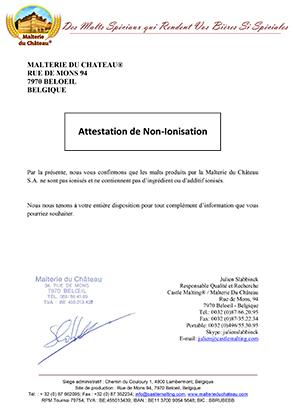 Castle Malting Malt Non Ionization Certificate FR
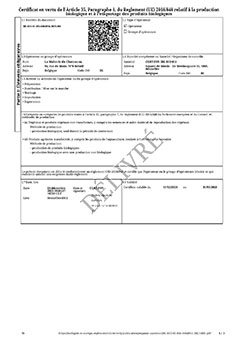 Certificat BIO FR: Malt, Houblon, Sucre - juillet 2025- mars 2028
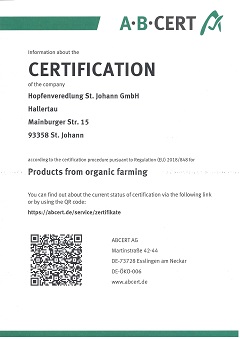 Hops, HVG, Organic Certificate 2024
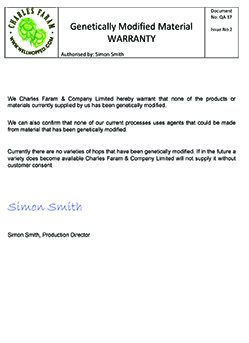 ChF Hops GMO-free Certificate
Suggestion
Join us



 Germany: Brewers forced to adapt as Gen Z increasingly chooses alcohol-free
Gen Z’s abstention from alcohol isn’t only happening in Germany, which produces the most beer on the continent. Young people are also drinking less across Europe and in the US, Yahoo!Finance reported on August 17.
Over the course of its 172-year-history, the Lang-Bräu brewery in the north of Bavaria has weathered two world wars and the fall of the Iron Curtain, whose defenses once stood less than thirty minutes away. But money troubles in recent years proved more than the small operation could handle. Facing €12 million in costs for much-needed upgrades, the owners decided last summer to shut everything down.
“Breweries are capable of incredible suffering,” said Richard Hopf, who led the family business and is now overseeing its closure. “But when sales fall and costs keep going up, it leaves little room for long-term considerations.”
Lang-Bräu is in a situation that’s familiar to many German brewers. Between inflation and higher energy prices, financial pressures on beermakers are mounting. Adding to this uncertainty is another sobering development: in a country long defined by its beer culture, fewer young people want to consume alcohol.
For many Germans in Gen Z — which includes anybody born between 1997 and 2012 — beer is no longer a daily ritual but a rare indulgence. And when they do enjoy the occasional wheat beer or pilsner, they’re increasingly likely to choose an alcohol-free option.
Some breweries have made moves to adapt — more than 800 varieties of alcohol-free beer are now available in Germany — but this hasn’t offset a broader decline. The average German now consumes 88 litres of beer in a year, down from 126 in 2000. And in the first half of 2025, the nation’s statistics office registered a 6.3% drop in beer production, a new low.
“It’s frankly worrying,” said Holger Eichele, who leads Germany’s brewer association. “The conditions aren’t good. Even those who’ve run their business for many centuries might be forced to give it up now.”
Gen Z’s abstention from alcohol isn’t only happening in Germany, which produces the most beer on the continent. Young people are also drinking less across Europe and in the US. There are various reasons for this: younger people have less disposable income than previous generations, wellness movements are on the rise, and there is greater awareness of the health risks associated with drinking.
“I’d never order it,” Carla Schüßler, a student in southwestern Germany, said of beer. In her generation, “it’s clear to everyone that alcohol isn’t good for your body.”
Beer’s high calorie content also doesn’t sit well with image-conscious Gen Zers. Fitness influencers routinely post about alcohol’s adverse effects, warning that it hampers fat burning and muscle building. “It’s just hard to improve your fitness level while drinking,” said Luke Heiler, a 22-year-old who works in a chemical laboratory and exercises regularly.
As these views become more common, Germany’s roughly 1,500 breweries are having to adapt. And not all have been able to: between 2023 and 2024, 52 breweries closed across the country — the largest decline in at least three decades.
Those who can are rethinking their product range to include more beers mixed with soda, known as radlers, and sparkling juice drinks. Billboards at train stations and ads on TV now promote alcohol-free fun — a once unthinkable development in a country known for Oktoberfest, and which still upholds a 500-year-old law mandating that beer contain no more than four essential ingredients.
Amid all these changes, perhaps the biggest is the boom in alcohol-free beer. While 9 out of 10 beers sold in Germany still contain booze, production of non-alcoholic beer — defined as anything containing less than 0.50% alcohol by volume — has nearly doubled over the past decade.
“We don’t think our flagship beer, which contains alcohol, will achieve major growth in the coming decades in Germany,” acknowledged Peter Lemm, a spokesperson for Krombacher, one of the nation’s largest beermakers. “Clearly, the growth area is low- or non-alcoholic beer.”
For brewers, developing alcohol-free versions of their beer isn’t a problem. The challenge is getting them to taste like the real thing.
Those who can afford to will often opt for a process in which beer is brewed normally, with the alcohol removed in an extra step once fermentation is finished. At Krombacher’s plant in the Western German city of Kreuztal — where beer flows through pipes across different parts of the building — this is integrated into a weeks-long process.
That level of precision manufacturing, however, isn’t available to everybody. “Small breweries usually can’t afford to take out the alcohol after,” said Thomas Becker, a Munich-area professor who specialises in beermaking. The equipment alone, he added, requires “an investment in the region of €1 million.”
Instead, small breweries often resort to an easier method, which involves stopping the fermentation process before it’s completed. While it doesn’t require additional investment, in most cases, drinkers do notice the difference as the result is usually sweeter than normal.
Entering the alcohol-free market as a smaller brewer also presents other challenges. It’s tough to break into a field that’s already saturated, especially when bigger players are better positioned to release new drinks quickly and buy up the trademarks of established brands.
To local breweries like Lang-Bräu, which are already under heavy financial stress after years of dwindling sales, these obstacles can be fatal.
The brewery never attempted to make its own alcohol-free beer, Hopf said. But given how many options are already on the market, he added, he doesn’t think it would have made much of a difference.
Back